Showing posts with label Media Bias. Show all posts

Tuesday, October 30, 2012

"Bounce Nation" Holds Protest at Local Radio Station, Station Management Threatens Arrest

Reposted from the Alliance Institute:

Supporters of bounce music culture rallied on Oct. 18th in front of 201 St. Charles, home of Cumulus Broadcasting and 102.9FM Radio, asking that station management reinstate the “Power Posse” morning show.

Recently the “Power Posse” was taken off the air to make room for the “Rickey Smiley Show,” a nationally syndicated radio program.  “We don’t oppose syndicated radio, however, we just want to keep our local musicians and artists working,” said Bounce Nation community organizer and bounce rap artist Crystal “Crowd Mova” Dixon.

Supporting local musicians and artists and keeping local jobs here in New Orleans should be a top priority of all groups, organizations, and companies doing business here in the city, said Dixon.

The Bounce Nation rally brought together bounce rap artists and supporters, as well as ministers from several local churches.

“We know that our future is inextricably bound up and linked with young people,” said Pastor Dwight Webster of Christian Unity Baptist Church, addressing the crowd gathered in front of the building entrance. “This bounce phenomenon is not something that’s going to go away, but the jobs are going away. If we don’t pay attention to what is necessary to keep the local jobs here and support the local efforts, we’re going to lose our young people.”

Bounce Nation collected over 1000 signatures from New Orleans youth and other bounce music supporters calling for the reinstatement of the “Power Posse” morning show. In addition to being the only local morning radio show targeting New Orleans Youth and Bounce Culture, the “Power Posse” promotes local artists who in turn create jobs for youth and positively contribute to the local economy.

Bounce Nation representatives attempted to turn in the petitions and a letter to the 102.9 program director at the Cumulus Broadcasting office on the 2nd  floor, but were barred from entering by building security personnel. The head of security said that Cumulus management did not want to let Bounce Nation and rally participants inside the suite and refused to accept the petitions, and then asked the contingent to leave the building altogether or risk being arrested.

Bounce Nation is a youth empowerment project of Alliance Institute that uses bounce music culture as a way of helping young people establish a voice for themselves and impact the future of New Orleans.

Friday, July 1, 2011

Did New Orleans Media Contribute to Police Violence After Hurricane Katrina?

This article originally appeared on Truth-Out.org:
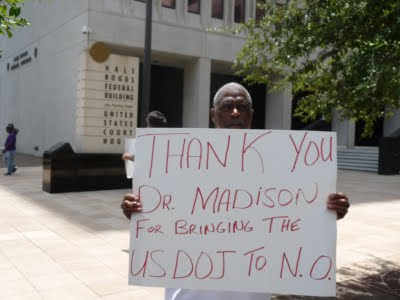
Opening arguments began on Monday, June 27 in what may be the most important trial New Orleans has seen in a generation. It is a shocking case of police brutality that has already redefined this city’s relationship to its police department, and radically rewritten the official narrative of what happened in the chaotic days after Hurricane Katrina. Five police officers are facing charges of shooting unarmed African-Americans in cold blood, killing two and wounding four, and then conspiring to hide evidence. Five officers who participated in the conspiracy have already pleaded guilty and agreed to testify against their fellow officers.

The shootings occurred on September 4, 2005, as two families were fleeing Katrina’s floodwaters, crossing New Orleans’ Danziger Bridge to get to dry land. Officers, who apparently heard a radio report about shootings in the area, drove up, leapt out of their vehicle, and began firing. Ronald Madison, a mentally challenged man, was shot in the back several times, then reportedly stomped and kicked by an officer until he was dead. His brother Lance Madison was arrested on false charges. James Brissette, a high school student, was shot seven times, and died at the scene. Susan Bartholomew, 38, was wounded so badly her arm was shot off of her body. Jose Holmes Jr., Susan's nephew, was shot several times. Witnesses say that as he lay bleeding an officer stood over him and fired point blank at his stomach. Two other relatives of Bartholomew were also badly wounded.

Danziger is one of at least nine incidents involving the NOPD being investigated by the US Justice Department, several of which happened in the days after the city was flooded. Officers have recently been convicted by federal prosecutors in two other high-profile trials. In April, two officers were found guilty in the beating death of Raymond Robair, a handyman from the Treme neighborhood. In December, a jury convicted three officers and acquitted two in killing Henry Glover, a 31-year-old from New Orleans’ West Bank neighborhood, and burning his body.

From Survivors to Looters

In the aftermath of Hurricane Katrina, people around the world felt sympathy for New Orleans. They saw images of residents trapped on rooftops by floodwaters, needing rescue by boat and helicopter. But then stories began to come out about looters and gangs among the survivors, and the official response shifted from humanitarian aid to military operation. Then-Governor Kathleen Blanco sent in National Guard troops, announcing. “They have M-16s and are locked and loaded. These troops know how to shoot and kill and I expect they will.” Warren Riley, at that time the second in charge of the police department, reportedly ordered officers to “take the city back and shoot looters.”

In the following days, several civilians – almost all of them African American - were killed under suspicious circumstances in incidents involving police and white vigilantes. For years, family members and advocates called for official investigations and were rebuffed. “Right after the hurricane there were individuals and organizations trying to talk about what happened on Danziger,” says Dana Kaplan, executive director of Juvenile Justice Project of Louisiana (JJPL), a legal and advocacy organization based in New Orleans. “But their voices were marginalized.”

There is evidence that local media could have done a better job. Alex Brandon, a photographer for New Orleans’ Times-Picayune newspaper who later went on to work for Associated Press, testified in the Henry Glover trial that he knew details about the police killings that he didn’t reveal. “He saw things and heard things that proved to be useful in a criminal investigation. He didn't report them as news," wrote Picayune columnist Jarvis DeBerry after the Glover trial concluded.

Victims of police violence have also complained of the media’s role. William Tanner, the good Samaritan who had tried to save Henry Glover, spent years trying to tell his story to local reporters. “When I told the media about the NOPD burning my car, they called me a raving idiot,” he says. “They didn’t want to give me the time of day.”

Former Orleans Parish District Attorney Eddie Jordan, who led an initial investigation of the Danziger officers, believes an indifferent local media bears partial responsibility for the years of cover-up. “They were looking for heroes,” he says. “They had a cozy relationship with the police. They got tips from the police, they were in bed with the police. It was an atmosphere of tolerance for atrocities from the police. They abdicated their responsibility to be critical in their reporting. If a few people got killed that was a small price to pay.”

Family members and advocates tried to get the stories of police violence out through protests, press conferences, and other means. Peoples Hurricane Relief Fund, an organization dedicated to justice in reconstruction, held a tribunal in 2006 where they presented accusations of police violence – among other charges – to a panel of international judges, including members of parliament from seven countries. Activists even brought charges to the United Nations, filing a shadow report in February 2008 with the UN Committee on the Elimination of Racial Discrimination in Geneva.

But it was not until late 2008 that a journalist named AC Thompson did what the local media failed to do, and published a detailed investigation of these stories. “It’s unfortunate that it took a national publication to really dig to the root,” says Kaplan, referring to Thompson’s work. “In New Orleans the criminal justice system has been so corrupt for so long that things that should be shocking didn’t seem to be raising the kind of broad community outrage that they should have.”

In 2009, after years of pressure from activists and the national attention brought on by AC Thompson’s reporting, the US Justice Department decided to look into the accusations of police violence. This has led to one of the most wide-ranging investigations of a police department in recent US history. Dozens of officers are facing lengthy prison terms, and corruption charges have reached to the very top of the department.

The Danziger trial is expected to last two months. Kenneth Bowen, Robert Gisevius, Anthony Villavaso, and Robert Faulcon, the officers involved in the shooting, could receive life sentences if convicted. Sergeant Arthur Kaufman, who was not on the bridge, is charged only in the conspiracy and could receive a maximum of 120 years. Justice Department investigations of other incidents are continuing, and it is likely that some form of federal oversight of the department will be announced in the coming months.

Monday, September 27, 2010

Wishing for Reality, Not for Another Disaster, By Wadner Pierre

MSNBC announced that it will be hosting presentation entitled “Wishing for a Disaster” based on the recovery of New Orleans. It has been five years since Hurricane Katrina devastated New Orleans. This natural and man-made disaster took away thousands of lives. Some folks see Hurricane Katrina as a blessing for New Orleans because it has brought to light many of the pre-existing social problems. But, the question is, if Katrina was a blessing for New Orleans, who really profited from this blessing?

Hurricane Katrina brought attention to New Orleans as many other natural disasters brought attention to other countries like Haiti. It seems as if our government has created a disastrous system- a system relies on disasters as motivation to take action. When many lives are lost in disaster like Katrina, we cannot wish for another disaster to happen before change is made in our city.

MSNBC’s title may be seen as an inappropriate title, and even as an attack on New Orleans’ existing rebuilding efforts. It is a disrespectful title to the communities struggling to rebuild every day in their city. Katrina took away many lives. By no means should Hurricane Katrina be seen as a blessing for New Orleans.

Reform in New Orleans, whether it be in education, social justice, etc. should not wait for another disaster. Natural disasters must not be the way for officials whether local, state or federal to think about the reform that needs to take place in our City.

Hurricane Katrina left behind tears and heartbreak. It is hard to hear some people talk about Hurricane Katrina as a blessing for people in New Orleans. Instead, Hurricane Katrina’s aftermath taught us where we failed to help our people. We should serve with this lesson to prevent another disaster in our city whether a natural one, or the disaster of political self-interest.

Education, healthcare, and shelter are basic human rights. Reform in New Orleans cannot wait for another disaster. The reform we need in our city needs to take place now with all people, rather than with a select group.

Wishing for another disaster to bring change in New Orleans is a wish to see the disappearance of poor minority neighborhoods, since they are the most vulnerable ones. The wish for another disaster sounds once again as an inappropriate title for those who lost their loved ones, and those who are trying to rebuild their city.

Wadner Pierre is a Haitian photojournalist who currently resides in New Orleans, Louisiana. Originally from the city of Gonaives in Haiti, he regularly writes for the Inter Press Service (IPS) and Haiti Liberte. Wadner is a co-founder and frequent contributor to HaitiAnalysis.com, a media collective of young journalists. In 2007, he was a Project Censored Award recipient for his investigative journalism work on the impact of media and corruption in military policies.

Monday, January 25, 2010

Fear Of The Poor Hinders Rescue in Haiti

According to an article last week in the Times of London, "Fear of the poor is hampering Haiti rescue." Author Linda Polman reports that,

The rescue operation is becoming notorious for the slowness with which aid is reaching the victims. Five days after the quake hit, many places are still largely bereft of international aid. Not through lack of funds, supplies or emergency experts. Those are all pouring in from dozens of countries. But most of the aid — and aid workers — seems stuck at the airport.

Rescue teams have pulled survivors from five-star hotels, university buildings, a supermarket and the UN headquarters, all in Port-au-Prince’s better neighbourhoods. In poor areas, where the damage appears much greater, apparently forgotten victims report on Twitter that they have yet to encounter the first foreign rescuer.

Many aid workers are reported to have orders not to venture out without armed guards — which are not there at all, or only after long debates with the UN military command...

The Haitian people seem to scare aid workers more than Somali warlords, Darfuri Janjawid or Afghan Taleban. Frightened Dutch aid workers abandoned a mission without reaching the collapsed building where people were trapped, and frightened doctors have left their patients unattended.

The experience of CNN’s medical reporter, Dr Sanjay Gupta, is telling. In a makeshift clinic he encountered a Belgian medical team being evacuated in a UN bus. UN “rules of engagement” apparently stopped them providing security for the doctors. The Belgians took most of their medical supplies with them, to keep them out of the claws of robbers.

Dr Gupta and his camera team stayed the night, monitored the abandoned patients’ vital signs and continued intravenous drips — and they were not robbed. Some rescuers are leaning so much toward security that they will allow people to die.

The media are not helping. CNN rules in the rubble. “Outside of a military conflict, this is our biggest international deployment since the tsunami in 2004,” according to Tony Maddox, the managing director of CNN International. So the image of the aid operation being beamed back is primarily American — and one of the big problems is the American view of Haiti.

CNN won’t stop telling aid workers and the outside world about pillaging (the incidence of which — for the first four frustrating days at least — did not compare with what happened after Hurricane Katrina) and about how dangerous it is to distribute food, because of the likelihood of “stampedes”.

Nor is the US Government, the biggest player in the aid operation, doing anything to help to relax the atmosphere. On the contrary. When President Obama said that the US aid effort would be “aggressive” he meant it. The humanitarian operation is not led by civilian agencies, but by the Pentagon.
As we continue to watch the coverage of this disaster and it's aftermath, we can't help but think that both the US media and our government have a lot to answer for.

Monday, January 18, 2010

Shame on You Anderson Cooper

Anderson Cooper, the people of New Orleans taught you, in the days and weeks post-Katrina, about the plight of disaster victims and our desperate need to survive. You learned from us how important is water when you are left without shelter in a warm/tropical climate. You learned from us how desperate a parent becomes when she sits for days on end listening to her child cry out for food. And you learned from us the damage media and journalists can cause by exaggerating rumors of violence and chaos.

We taught you this.

Unfortunately, now some 4.5 years later, you lost these lessons on the way to Haiti, as evidenced by your live story today describing as ‘looters’ and ‘thieves’ the Haitian victims struggling to enter any and every grocery store accessible – to obtain food and water – to survive.

Unbelievably, your report was sympathetic of Tony Bennett, the Miami ‘businessman’ who has armed himself and two (2) Haitian police with glocks and automatic weapons, and barricaded a Port-au-Prince street in order to keep these starving earthquake victims from taking food and water from his store. (To see the report, click here)

What’s wrong with you Anderson?

A responsible journalist would have been questioning the sanity and humanity of Tony Bennett, this Spawn of Satan, for ever contemplating closing his business and denying basic survival means to these victims. Here are a few questions you might have asked him:

 “Why are you treating these victims this way? Is there some big market the rest of the world doesn’t know about for food recovered during a natural disaster? Where, exactly, are you going to sell this water?”
 “Sir, instead of arming what is now your own private militia, why don’t you ask these Haitian police officers to help you distribute these perishables so that these mothers won’t have to pay for water, and food, and baby formula?”
 “Excuse me, Mr. Bennett, I’m just curious. How are you going to sleep tonight, knowing you’ve denied food and water to hungry children?”

See Anderson, you know the difference between “looter/thief” and “survivor” and, most importantly, how to report accurately this distinction. We taught you that. You know how to identify and expose a disaster capitalist. We taught you that. You know how to report accurately from ground-zero of a major natural disaster. We taught you that.

Shame on you, Anderson Cooper, for forgetting your lessons and, in the process, re-victimizing the people of Haiti. You know better.

Tracie L. Washington is an attorney and Co-Director of Louisiana Justice Institute, www.LouisianaJusticeInstitute.org.