Showing posts with label Mardi Gras Indians. Show all posts

Monday, February 24, 2014

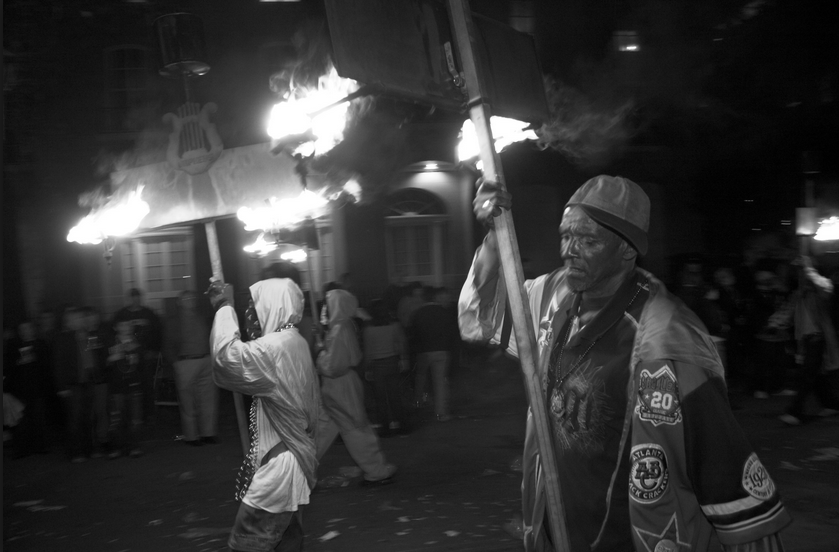
Glambeaux: Taking Cultural Appropriation Too Far, by Gianna Chachere


Every day New Orleans is faced with crime, racist activity and the never-ending gentrification debate. But there is something about Glambeaux, the new all-female flambeaux troupe marching in Thursday’s Muses parade, that forces me to speak. I’ve had enough with the appropriation of my culture/home by those desperate to be seen, to be hip, and be ironic. 

The cultural appropriation of New Orleans has a very long pre- Katrina history but it has accelerated quickly in the last few years. After the storm, the acculturation by the “New” New Orleanians has zigzagged its way into every facet of New Orleans culture and identity. “Natives” and "Non-Natives” alike, desperate to revive the economy and speed recovery, have relied on the city’s unique cultural life to bring the city back from the brink of extinction. For example, Mayor Mitch Landrieu invited Mardi Gras Indians and the Rebirth Brass Band to perform at his inauguration. 

What’s clear and disturbing is that this cultural appropriation won't end anytime soon and that the damage caused seeps into every aspect of daily life. The city’s cultural landscape is saturated with new incarnations of rituals and events that have morphed into meaningless trends, giving them a significance that is completely different and less nuanced than its original intent. In particular, the traditions that originated and existed in the African-American community are suddenly receiving praise and attention - but not for its originators. 

This occurs at a time when the city continues to enforce restrictions on cultural activity in African American communities while neglecting to bring social and economic progress to all the city’s citizensNew Orleans has long been a patchwork of different cities, each new wave of immigration attached on top of the still visible last, incorporating the intricacies of local traditions and culture. Within these neighborhoods, there existed invisible boundaries and a general respect for the traditions/culture held within. New Orleans has always resisted a “curated” urban space representing a single-minded expression. That resistance has allowed the city to flourish and entice new comers with a unique cultural landscape. Far from suggesting that we resist new traditions and rituals, I ask those engaged in these new trends to consider the history behind these traditions/rituals and understand that using someone else’s cultural symbols to satisfy one’s own personal need for self-expression is a selfish exercise in privilege and entitlement. 

Have the Glambeaux krewe done any basic research on the history of the flambeaux? After a 30-second search on the Internet, I found the following: ”The original flambeau carriers were slaves of the wealthy that organized the parades. After the abolition of slavery, the carriers continued to be all African-Americans and it is only until very recently (and still very rarely) that other races participate in the tradition. For their work, carriers are paid a small fee by the parading krewe but the bulk of the money made from the evening comes in the form of coins or dollars thrown from the crowd. Twirling and general clowning are expected from the carriers, which brings more money raining down.”

Of course the Glambeaux have a right to do whatever they choose to do. Many argue that the Mardi Gras’ motto of “do what ya wanna” allows total artistic expression to exist and flourish but I feel that there should be recognition of what came before and an acknowledgement of those who created these traditions. And why would you want to glamorize something rooted so deeply in desperation and racism?

As a very young girl in the 1970’s, watching the flambeau made me feel uncomfortable. Neglecting to consider the history behind this tradition is insensitive and disrespectful. I don’t think we should uphold the flambeau tradition as something sacred. In fact, it should be abolished as a demeaning and sad part of American history. 

The recent proliferation of young white folks who wear skull and bones costumes or better known as “skeleton gangs” that roam the streets of New Orleans on Mardi Gras is another example. Wearing a skull and bones costume is an “experience” for a white person to enjoy for a short time and discard later without a consideration for the history behind the mask. There should be some element of mutual understanding, equality, and respect for it to be a true cultural exchange – otherwise it is just taking. The Glambeaux krewe doesn’t wear their gear in a vacuum and there are many social and historical implications to treating this tradition merely as costumes. African Americans created their own Mardi Gras traditions because they were in effect shut out of white Catholic and Protestant celebrations (with the exception of Flambeau carrying).

Costuming for Mardi Gras Indians and skeleton gangs historically derived from a deep desire to perform and contribute and has never been a profit making entity. In fact, the tradition has continued due to the economic sacrifice of those involved, which appears to be lost on those currently mimicking the tradition.

As a tenth-generation New Orleanian, I am also a “New” New Orleanian. I moved back to the city after 16 years, purchased a home and look forward to enjoying my community of family and friends. What angers me is that through conversation, I realize my family’s personal history, historical knowledge and childhood memories, are registered as irrelevant to those intent on ignoring and disrespecting the social and historical complexity of this city. At 2013 Super Sunday, I saw a young man walk backward while furiously taking photos of Mardi Gras Indians. His “documenting” blocked the Indians’ ability to walk forward and impeded others from enjoying the spectacle. When I mentioned to the young man that he was obstructing everyone there to enjoy the day, he said, “don’t be a hater” and “mind my own business.” Respect, understanding and general good manners ARE my business and should be the business of everyone in the community. I’m fed up that this behavior is acceptable and lauded but also I’m fed up that my feelings of pain over the current state of culture and community in New Orleans is ridiculed. There is a profound loss and for those who recognize it – we should not be made to feel negative or hyperbolic about preserving the city’s history and culture.

People get defensive when you call them on culture appropriation because it threatens their sense of entitlement. Recently I hosted musicians from Toulouse, France and administrators from a New York-based foundation that supports programming in New Orleans. Both groups asked me the same question, how can the appropriation of New Orleans culture be so rampant and why are people not furious about the level of disrespect and entitlement forced upon the community by this behavior. People say you had to be in Paris in the ’20s or New York in the ’80s or New Orleans pre-Katrina. The disappointing truth is that you no longer need to be anywhere in particular anymore - ignorance and tastelessness is everywhere and has been taken to a whole new level.

Photo credit: New Orleans Mardi Gras: Flambeaux carriers, Krewe of Orpheus night parade, photo by Derek Bridges, licensed under the Creative Commons Attribution 2.0 Generic license.

Thursday, January 17, 2013

Turning Problems Into Parades, By Nick Slie

This weekend is MicroFest USA: New Orleans: RENEW. The event is a celebration of the renaissance that has taken place in New Orleans' performance and social justice fields since Hurricane Katrina.  Part festival, part think-tank, part community tour, and part dance party, the all-local programming includes workshops, learning exchanges, neighborhood tours, meals featuring locally produced food, and presentations by performance ensembles ArtSpot Productions, Cripple Creek Theatre Company, Goat in the Road Productions, Mondo Bizarro, and NEW NOISE and social justice organizations such as the Louisiana Bucket Brigade, Moving Forward Gulf Coast, New Orleans Workers’ Center for Social Justice.

Howl Round: A Journal of the Theatre Commons is commemorating the festival by hosting several essays by New Orleanians who work on art and social justice. Among the artists featured are Kiyoko McCraeJosé Torres-Tama, Lisa D'Amour, and Nick Slie, whose essay we are reprinting below. We encourage you to check out the festival this weekend.

The costume making skills of the average New Orleanian are astonishing. As I write, thousands of people in our fair city are busy sewing, beading, bedazzling and thrift store hunting. Today is Twelve Night, the official kick-off to carnival season. Since Mardi Gras Day is February 12th, the internal costume making radars of the entire city are now on alert. Thirty-seven days to the show. Thirty-seven days until food-laden neutral grounds, deep belly laughs, hundreds of marching bands, exhaustive dancing, family dinners and parades. Thirty-seven days until the largest collective ensemble performance in America: Mardi Gras. 

New Orleanians treat this season with reverence for so many reasons: (1) You are the show and everyone knows it. (2) It’s free and it takes place on the streets. (3) It is rooted in centuries old traditions. (4) It is the supreme example of how we use food, culture and music to bring people together to build and strengthen community.

In an ever-accelerating world, taking the time to gather people in person is becoming more radical by the minute. New Orleanians specialize in this and we do so with flare. Any chance to get together is a chance to celebrate. We’ll turn the average Saints watching experience at someone’s home into an event featuring enough fried food, pimiento cheese, booze, glitter and touchdown dances to inspire one to become a football fan. The same goes for an average Tuesday or Wednesday. From January to June, there are four days in Southeast Louisiana without a festival. Reflect on that. 

Everyday life is heightened to an art form here. In this city, the ordinary becomes extraordinary in an instant: a casual walk can result with you swept into a second line, surrounded by the chants of Mardi Gras Indians, swooned by wild jasmine or serenaded by the long wails of tug boats as they slug down river. And you can also hear gunshots, sirens, and the chorus of reminders that New Orleans boasts one of the highest per capita murder rates in the country; or the fact that over twenty-five percent of Louisiana residents live below the poverty line. 

The Crescent City is languid and tense, inspiring and downright brutal. Living here, especially since the storm, is a constant experience of life at its most rousing and most cruel. It is this juxtaposition that fascinates us and it is one of the reasons why our cultural traditions boast such a clear social function. After all, people did not become professional celebrators by accident. They learned to do so because life is hard and to dance, sing and eat through it, even if for a day, is one way to approach an explanation about the joys and calamities of daily life here. Our traditions are celebratory, yes, but they also serve the obvious social function of building community and, since the storm, rebuilding one of the most important cities in the world.

New Orleans is a city with no money but resourceful people who, above all, have one thing on their hands: time. People here have a lot of time and they are generous with it. There are few folks in town that would deny you an hour over coffee –fewer that would turn down the same over beer and dancing. People are accessible and down to earth. What we lack in money, we make up for in spare minutes. I imagine this is one of the reasons people have been migrating here for the last three hundred years. 

Think of time here not just as duration but as density of experience, one of the essential ingredients for making good art. Things (and change) move slowly here. Take this and factor in the aforementioned love of gathering people in live, celebratory public environments and you get an idea of why New Orleans is a perfect incubator for ensemble theater practice.

This week, we will play host to Network of Ensemble Theater’s (NET) Micro-Fest USA: Renew, the third installment in a series of festivals that looks at America and the role that art and artists play in creating healthy, vibrant communities. Ensemble has been the big buzz in the theater world over the last few years. In that time, NET has bravely matured into a national service organization that takes risks and innovates ahead of the curve, engendering a vibrant critical dialogue about ensemble theater making on all fronts. At a time when so many people are excited about ensembles, NET has taken the time to remind us that ensemble theater is not a formula, it is a practice. It cannot be applied instantly. It takes time and a willingness to fail in an honest, forthright manner. 

In this regard, NET is clearly steering the most interesting, nuanced conversation about ensemble theater practice in America. And here NET is again, using these Micro-Fests to get out in front of the conversation about ensemble theater practice by encouraging us to expand the very notion of what ensemble means and how it is applied in one of the most embattled places in the country. The Micro-Fest programming accomplishes this by magnifying how ensembles are using art and advocacy within cross-sector partnerships to create experiences that are as impactful as they are exciting.

The exciting evolution of NET over the last seven years parallels the rapid growth of the New Orleans theater community during the same time. Before the storm, there were many who laid the foundation for what is happening now. Companies and institutions like The Free Southern Theater, Le Petit Theatre Vieux Carre, Junebug Productions,Southern Rep, Le Chat Noir, Anthony Bean Community Theater, Chakula Cha Jua Theater, Dog and Pony, Arte Futuro Productions, ArtSpot Productions, Kumbuka African Drum & Dance Collective, Running With Scissors, Evangeline Oaks, Tsunami Dance, Mondo Bizarro, Inside Out Productions, Sidearm Gallery, CAC and Ashe Cultural Art Center steady the broad (and often unacknowledged) shoulders upon which we stand. 

Since Katrina, we have seen an in-flux of talent and energy into the city, the likes of which has transformed New Orleans into a theater ecology that is swiftly asserting itself as a scene to be watched. This has occurred through a combination of risk, fearlessness and an unprecedented spirit of cooperation and resource sharing between individuals and companies alike. Such new companies and institutions include: Allways Lounge and Marigny Theater, Goat in the Road, Cripple Creek Theater Company, The NOLA Project, NEW NOISE, Skin Horse Theater, The Shadowbox Theater, The Neutral Ground Ensemble, Theater 13, Elm Theater, St Francisville Transitory Theater and the New Orleans Fringe Festival, Dancing Grounds, Night Light Collective, Mudlark Public Theater, and the Black Forest Fancies, to name a few. All of this begs the question: how and why has this happened so fast?

With regards to NET and the New Orleans Community, there are too many factors to name but the truth is, people have been doing this type of work for years. NET was smart enough to capitalize on this movement, recognizing the need for ensembles to frame their own experiences and practices: to define ourselves. In New Orleans, the impulse was similar but heightened by the reality that one of the nation’s most unique cultures was visibly threatened, on the verge of extinction. Like the plants that immediately bloomed after the storm as a means of survival, our job was to flower into action immediately. 

This charge continues today. Many point to ensembles fulfilling a need that larger institutions like regional theaters no longer serve. I hear that, but it only scratches the surface; there is something deeper. The recognition of ensemble practice—flourishing via NET and New Orleans—exemplifies a longing in people for experiences that are meaningful in the face of an increasingly over-simplified, instantaneous reality. The notion that we can have everything we want right now has asserted itself as a cliché that in the modern age has become cunning and directionless, as it does nothing to address the chronic nature of so many of the problems our communities are experiencing. In the face of this, ensembles root into places, using their craft to create experiences and relationships that, by responding to the timescale of the place where they live, enhance their role as stakeholders and amplify the stakes in that community. When stakes are high, we are compelled to go even closer, to approach and approach and approach.

In an era when we mistake mimicry for mastery, information for explanation, there is something downright enlivening about a group of people who craft experiences that engage the community where they live, ask questions of which they do not know the answers, and labor with one another for decades. This is what ensembles do and in the process they bravely approach the eradication of the instant results cliché. Ensembles allow time for their social function to become more apparent, often resulting in a body of work that is interesting and important. There is nothing new about this approach, though it may feel novel due to its proximity to the current times.

As the sage Ricardo Levins Morales reminds us, every ecosystem needs its poisons in order to create functioning antibodies. The theater community in New Orleans (and across the country) has some big poisons that need addressing. We are not in a sustained dialogue about the reality of race and racism and because of this we are not as unified as we should be. We do not have a healthy critical dialogue about the quality of the work (bar chatter is only part of it) we are creating and its impact on our home. We rarely, if ever, discuss who in our community is making a living. And we have not done a good enough job of acknowledging our ancestors and the labor they have contributed (how many New Orleanians can speak with passion about The Free Southern Theater, one of the most significant theater movements of the 20th Century?). 

These poisons left unchecked will eat us from the inside out. We need to develop the necessary antibodies to function with more communal health. That is, if we want this scene to blossom into a movement where theater has a pronounced social function beyond vanity alone. Considering the current state of New Orleans, all we’ve come through together, all the jitterbug nights and the complexity we have seen over the last seven years, wouldn’t it be remarkable? If not us, who? I mean, who knows better how to turn problems into parades?

Monday, January 30, 2012

Big Freedia And The Week New Orleans Took Over The World


Last week, New Orleans rapper Big Freedia made her national television debut on the Jimmy Kimmel Show. Freedia, who has been quickly taking the nation by storm, performed two songs "Excuse," and "Na Who Mad."


Although the network appearance was Freedia's national television debut, she showed no sign of nervousness. The breathtaking performance featured all the dance moves New Orleanians have come to expect from a Bounce show, and all the energy audiences everywhere have come to expect from Freedia.

Coming in the same week that New Orleans filmmakers won the top award at Sundance Film Festival, and soon after some long-deserved recognition for Mardi Gras Indians and local organizers, we hope this represents a resurgence for New Orleans, led by our brilliant artists and community activists.

Thursday, January 5, 2012

City Council to Establish Allison “Big Chief Tootie” Montana Day

From a press release from Faces of Culture/Allison Montana Institute of Art, Culture, and Tradition Yellow Pocahontas Mardi Gras Indian Tribe:
New Orleans City Council Pays Tribute to the Legacy Of Allison “Big Chief Tootie” Montana by Acknowledging and Establishing the first day Carnival /Mardi Gras as the Allison “Big Chief Tootie” Montana Day in the City of New Orleans

Today at 10am, members of the New Orleans City Council and Mardi Gras Indian tribes, community members, supporters, friends, and family gather in City Council chambers to pay tribute to the legacy of Allison Marcel Montana, “Big Chief Tootie” “Chief of Chiefs, and Chief of the Yellow Pocahontas Mardi Gras Indian Tribe. Allison Montana, a master artisan, dedicated more than 53 years to the indigenous cultural tradition of “Masking Indian.”

June 27, 2005, Allison “Big Chief Tootie” Montana, a cultural warrior and leader, tragically passed away while he was addressing the Council on the unwarranted, violent, and illegal assault on Mardi Gras Indians, neighborhood residents, senior citizens, and children. Big Chief Tootie was in the middle of recounting half of a century of history of police harassment and abuse when stricken. His last words were “I want this to stop.”

Television news cameras captured his fall as the chiefs and others who loved and respected him took up the hymn “Indian Red.”

After his passing, the public hearing was originally scheduled to reconvene in September of 2005 but, because of Hurricane Katrina, the levee breach, and the aftermath, a hearing was never rescheduled. Today, establishing the first day of Carnival/Mardi Gras as the Allison “Big Chief Tootie” Montana Day will serve as impetus for conversations among members of the New Orleans City Council, City Administration, the New Orleans Police Department, and all Cultural Bearers, namely, the Mardi Gras Indians, to address the lack of understanding and appreciation for indigenous traditions unique to our city. Most importantly, these conversations, along with policies and procedures regarding culture and traditional practices will end the harassment, disrespect, and cruelty exhibited by some police officers.

Seven years after his passing, those same cruelties Big Chief Tootie spoke of continue today. It must stop!

Allison “Big Chief Tootie” Montana died a warrior’s death in council chambers fighting for the respect of a cultural tradition that defines the City of New Orleans. Today the Indian community hopes the city will provide real and lasting protection and respect for the indigenous traditions of the Mardi Gras Indians and all Cultural Bearers as well as develop a profound understanding of those they aim to serve and see the world as the cultural community sees it. The Mardi Gras Indian community, supporters, friends and family of Allison "Big Chief Tootie” Montana appreciates the leadership and commitment of the New Orleans City Council. Collectively, we look forward to the city taking more permanent action to ensure that the sacred tradition is forever respected and protected. Moreover, the yearly acknowledgement and celebration of the legacy of Allison “Big Chief Tootie” Montana will spark the interest of the young, perpetuate the “Masking Indian” tradition, and ensure full protection and respect for New Orleans indigenous cultural traditions.

The public is invited to attend a wreath laying by the Montana family at the Allison “Big Chief Tootie” Montana statue inside of Armstrong Park at 4:00 pm on Friday January 6, 2012 followed by a Mardi Gras Indian Film Festival at 5:00pm at the Golden Feather Mardi Gras Indian Gallery and Restaurant located at 704 North Rampart Street across from the historic Congo Square.

Wednesday, March 10, 2010

Exclusive Video of Police Harassment of Mardi Gras Indians

On Monday, journalist Katy Reckdahl ran a powerful story in the Times-Picayune exposing police harassment of Mardi Gras Indians in Central City on Mardi Gras Day. For many community members, this revived memories of previous police harassment, especially on St. Joseph's Night of 2005, when police broke up the Indian tradition by driving through at high speeds, cursing at and threatening Indians and others, and even making arrests.

Below is exclusive video of the Mardi Gras day police harassment of Mardi Gras Indians described in Reckdahl's story. The footage - shot from a cel phone - is very low-resolution and shaky, but it documents the chaos, sirens, and overall atmosphere of terror generated on that day.

The video was shot by Michelle Conerly, a certified nursing assistant who lives on the block the incident occurred. Conerly also managed to write down the car numbers of six of the seven police cars who caused the panic (the seventh was a black undercover car).

The police car numbers were 603, 903, 609, 0088, 03076 and 01020.

In a recent interview, Mayor-elect Mitch Landrieu has said our city needs “a complete culture change in the New Orleans Police Department." A good first step would be to bring respect for New Orleans' cultural traditions to the police department.

Police Brutality of Mardi Gras Indians from Lily Keber on Vimeo.

Thanks to local filmmaker Lily Keber for her help in posting the video online.