Wednesday, March 21, 2012

Race, Gender, and Occupy By Sweta Vohra and Jordan Flaherty, Fault Lines

A version of this article originally appeared on the Al Jazeera website.

At a recent panel discussion on the Occupy movement, a left-leaning professor from New York University speculated that identity politics - the prioritizing of issues of race and gender in movements for justice - could be a plot funded by the CIA to undermine activism. While most commentators do not go this far, the idea that activists who focus on these issues are "undermining the struggle" has a long history within progressive organizing. And in Occupy Wall Street encampments around the country these debates have often exploded into public view.

For the past six months, we have been following the Occupy movement for a two-part documentary on Occupy for Fault Lines. We have spent weeks in conversation with activists as they have planned actions and struggled to keep their movement relevant through a cold winter. And organizers have told us repeatedly that they feel these discussions around race and gender, far from weakening the movement, have lent it strength and made organizing more accountable to the communities most affected by the economic crisis.

The process of challenging structural oppression has been difficult. We spoke to many women and people of color who felt pushed out of Occupy. Some activists, already bruised by dismissive media coverage, tried not to let these conflicts show. When internal conflicts would arise they tried to not let it happen on camera. But what we did observe are many fiercely intelligent activists dedicated to waging these struggles within Occupy and strengthening the movement with their work.

The 99 per cent

When people gathered in Zuccotti Park on September 17, the anger at corporate greed was a unifying call. This was a protest that in large part was about shifting power from the wealthy to the many. It was a mostly white crowd, but it sought to incorporate a wide range of voices.

The economic crisis in the US had made the white middle class question their future. Soaring unemployment rates, suffocating student loan debt, and thousands of foreclosures began to close in. This reality propelled the Occupy movement forward. And many feel that the presence of so many relatively privileged white people brought increased media attention and public sympathy.

Organizers told us they immediately saw the next step as needing to raise awareness among the many young people new to activism that came flocking to occupations. "It's the job of the social justice movement to continue that conversation," says Max Rameau, a co-founder of Take Back the Land, who has advised many of the Occupies.

He told us that occupiers need to "make sure this isn't just a movement of the way white people have gone from being able to every day shop at particular malls, and now they have to shop at reduced, discount stores … this has to do, really, about inequality and long-term inequality, including communities who have suffered for years, not just because of the recent economic downturn."

Many women reported harassment in the camp, and even assault - especially those that stayed overnight. "I think there were some (Occupy camps) that allowed homophobia and sexism to thrive in a really significant way," says Rameau. "I think homophobia and sexism in society exist everywhere, but were allowed to thrive in some of these areas."

Manissa Maharawal, a PhD student and Occupy activist, said: "I love the discourse of the 99 per cent. I think it's great, I think it's been really unifying. But I would like it to go along with saying something like, ‘We are the 99 per cent, but the way that we experience the 99 per cent can be very different.'"

Jack Bryson, a 49-year-old Black public service worker, became an activist after his sons witnessed the killing of their friend Oscar Grant at the hands of transit police in Oakland. When he heard that Occupy Oakland had named their camp Oscar Grant Plaza, he came to check it out. He was excited by what he found, but also thought many young white activists he met had a lot to learn about poverty and repression. "The black community, for 400 years, [have] always been the 99 per cent," Bryson said. "Welcome to our world."

Bryson was one of many who told us that Occupy activists needed to understand the ways in which communities of color experience the criminal justice system. He noted that Occupy Oakland had faced intense police repression. But, he told us, what many failed to realize was that police brutality is a daily fact of life in many communities. "Black, young men … would love to come out here. But what happens here, with the police? It happens on Saturday nights to Black young men leaving a nightclub, or a black young man going into a gas station and being followed by the police."

Boots Riley, a hip-hop artist and Occupy Oakland organizer, told us that he hopes the Occupy movement can challenge the ways that people have viewed policing. "I think that what happens normally is the media has most of white America looking at people of color as deficient, savage, and when they see something happen to them by police they believe that it was somehow their fault," says Riley. "Our ideas and views about the police are very tied in to our ideas and views about why people are poor."

If OWS wanted to be a movement that was going to shift power in the US, these organizers felt it had to come to terms with the fundamental differences in the ways that communities of color experienced racism, how women experienced patriarchy, and how queer and transgender communities experienced homophobia and gender bias. If Occupy Wall Street wanted to talk about envisioning an alternative community, activists would first have to face their own privilege.

That awareness has involved active engagement by white anti-racists, as well as the activists of color who committed deeply to the movement, despite often facing attacks for bringing up issues of race and gender.

"I was totally impressed by the leadership that was coming from young people of color, young women of color," activist and scholar Angela Davis told us in a conversation about Occupy camps she visited on the East coast.

"I think it's good that there's some white men getting involved, but they also have to recognize that, in order to be involved in this campaign of the 99 per cent against the one per cent, we have to recognize that the 99 per cent is hierarchically developed by itself."

Davis told us that Occupy was indebted to a long history of direct action led by women and by people of color. She specifically noted the legacy of resistance in prisons, led by those behind bars. "Let's recognize that we're not artificially imposing these issues on the Occupy movement," added Davis. "The Occupy movement has organically risen from those movements."

For Lisa Fithian, one of many white activists who seeks to challenge race and gender bias in the movement, this consciousness raising is a crucial part of struggling for justice."What I teach is that those with more privileges whether because your color of your skin, your gender, your education, whatever, how do you use those privileges strategically to raise those of all?"

"We have to take our privileges, become conscious and use them to actively change the social relationships, and access, and availability of resources," she added.

Blocking the process

Manissa Maharawal, a South Asian woman, has been one of Occupy Wall Street's most eloquent and passionate defenders. But she almost walked out of the movement on one of her very first visits to Zuccotti Park. When she, along with several people of color, stood up in front of hundreds of people to block a proposal at a very early Occupy Wall Street assembly, she felt anger and hostility from many of those present. She says it's "still one of the more intimidating things that I've had to do in my life". The proposal was for a document called the Declaration of the Occupation, and she felt language in the document erased oppression faced by people of color.

She did not want to have to block the proposal and face the angry stares of hundreds of people. However, says Maharawal, it's something she had to do. "What struck me then was that if I want Occupy to be something that's around for a long time in my life … it needs from the very beginning to be a movement that's taking these things on," she explained. "And that is thinking about not just corporate greed and financial institutions, but is thinking about how these things are connected to racism, to patriarchy, to oppression generally."

Ultimately, Maharawal and others who agreed with her succeeded in changing the language of the declaration. Nearly two months later, one of the white male activists who had expressed his frustration with her came up to her to thank her for her intervention. "I'm really glad you did that, I learned a lot right then," he told her.

"Making these connections is difficult, it's been like constant work in this movement," says Maharawal. But, she adds, "this stuff doesn't feel like minutia, it feels fundamental to me". She says this movement is about creating a real alternative to our current system, and, for her, that means fighting these systemic issues. "Why are we going to create a system that just re-creates all these oppressions? That recreates racism, that recreates oppression, that recreates gender hierarchy. Why would I want to be a part of that?"

Sweta Vohra and Jordan Flaherty are producers of Al Jazeera's Fault Lines. Fault Lines presents two special programs on the Occupy movement premiering March 20 & 27.

Tuesday, March 20, 2012

Two New Documentaries Explore Occupy Wall Street Movement

The Al Jazeera English television network has just released two new documentaries on the Occupy Wall Street Movement, produced by the award-winning current affairs program Fault Lines. The films can be seen on the Al Jazeera website and youtube. Below are the full credits for the films.Fault Lines: Occupy Wall Street

Part One: History of an Occupation
Fault Lines looks at how Occupy Wall Street went from a small group of New York protesters to a broad people’s movement in the US. Premieres March 20, 2012.


Part Two: Occupy Wall Street: Surviving the Winter
Fault Lines follows key Occupy organizers through the winter as they continue to build a movement even after violent evictions across the country. Premieres March 27, 2012.


CREDITS

Executive Producer

Mathieu Skene

Producers
Sweta Vohra & Jordan Flaherty

Correspondent
Sebastian Walker

Editor
Warwick Meade

Camera
Thierry Humeau
Singeli Agnew
Ralf Oberti
Trudy Hutcherson
Matt Bockelman
Eric Schneider

Additional Footage
Aggie TV - UC Davis
Ali Winston
Andrea Schmidt
David Martinez
Joshua van Praag
Luke Rudkowski
Marisa Holmes
Meerkat Media
Sara Kenigsburg/Huffpost

Interviews
Amin Husain
Angela Davis
Barucha
Boots Riley
Christopher M.
Clarence Thomas
David Graeber
Jack Bryson
Josh Boss
Lisa Fithian
Luis Moreno
Manissa Maharawal
Max Rameau
Mohamed Algohari
Nelini Stamp
Nell Myhand
Sandra Nurse
Scott Olsen
Thadeaus Gantry
Tim Pool
Trace

Additional Filmmakers (Footage did not end up in film)
Andrew Susich
Atiq Zabinski
Barni Qaasim
Cari Machet
David Morse
Geoff King
Josh Wolf
Luke Richardson
Maria Chunikhina
Renée Renata

Interns/Production Assistants/Volunteers
Abigail Deroberts
Arushi Sharma
Courtney Irvine
Kaitlin Loukides
Negin Owliaei
Paul Abowd

Special Thanks
Andrew Huckins
Andy Bichlbaum
Anjali Kamat
Arun Gupta
Brooke Lehman
Clare Bayard
Colin Moynihan
Dan Siegel
Diego
Elizabeth Falcon
Feliz Solomon
Gemma Mirkinson
Geoffrey Wildanger
Hena Ashraf
Holly
James Ploeser
Jean Ross
Causa Justa/Just Cause
Karanja Gaçuça
Katy Romer
Laura Gottesdeiner
Leah Lakshmi Piepzna-Samarasinha
Liz Butler
Lydia Pelot-Hobbs
Maria Poblet
Marina Sitrin
Matt Smucker
Melisa Spence
Michael Ellick
Michael Haack
Michael Premo
Michael Thompson
Mike McSweeney
Mohamad Ezzeldin
Mona Lisa Trevino
Natasha
Nathan Brown
Nora Callahan
Regan Brashear
Ricky Lehner
Ryan Devereaux
Sam Jewler
Sara Shaw
Sarah Lane
Sean Devlin
Shaw San Liu
Shon Whatevaya
Sonny Singh
Suresh Naidu
Tim Franzin
Tom Hintz
Tracy Van Slyke
Valery Jean
Vasudha Desikan
Yes Labs

Saturday, March 17, 2012

“Parents’ Guide” Publisher Aesha Rasheed Talks Public Education in New Orleans; Interview by Rosana Cruz

From our friends at Bridge The Gulf:
As the parent of a New Orleans Public School student I can tell you, the reality of sending your child to school has completely changed from when many of us were growing up. When I was a kid, we went to our local neighborhood schools. In New Orleans, since Hurricane Katrina, just sending your child to the closest school is no longer an option. Once a child reaches school age, parents have to walk through a maze, from different registration and application processes; different school calendars; different eligibility requirements for students; to different interventions and services for children with special needs (for schools that have them at all.)

Puzzling through the confusing and very long list of “options” is a frustrating and time consuming process for even the most patient, well equipped and well informed parent. But without one basic tool, I think it would be nearly impossible. That tool is the New Orleans Parents’ Guide to Public Schools, published and distributed by New Orleans Parent Organizing Network. This combination catalogue and guidebook comes out every February, in time for students to review before the application deadlines for many schools.

Download the Parents' Guide here.

Parents: This year the Recovery School District (RSD) has a unified application, due on March 31st. (This is only for RSD schools, for other schools' enrollment information visit NOLAPON.org.)

The 6th edition of the Parents’ Guide just came out, so I sat down with my friend Aesha Rasheed, the publisher of the Parents’ Guide, and the founder and former Executive Director of New Orleans Parent Organizing Network. What was going to be a 20-minute interview turned into a fascinating hour-long conversation about the history and broader landscape of public education in New Orleans. Both of us are outraged about the continuing racial and socio-economic disparities that have persisted in Education and impact the larger community in a myriad of ways, but first I wanted her to explain how we got to where we needed a Parents Guide. Here’s part one of that conversation.

Will you please tell me what Parents’ Guide is?

The New Orleans Parents’ Guide to Public Schools is an annual book to help parents understand the landscape of public schools in New Orleans, get some basic information about what schools are open, where they are, what kind of programming they provide, what kind of student population they serve and what their academic performance is. Parents can use it to inform their choices and compare and contrast what is happening at different schools. It is also meant to be an advocacy tool, to hopefully raise the level of parent dialogue about what quality looks like at schools.

How did the parents guide come to be? This is the sixth edition, right?

This is the sixth edition! I was education reporter in New Orleans before the flood. After Hurricane Katrina and the flood, as people were trying to figure out returning and rebuilding, I got lots of questions from colleagues, friends and neighbors, who knew that I knew something about schools. They were like, "Is this school open? I've heard such and such. I heard Capdau is open. Is that true? But I went by the building and it looked like it was flooded."

By then there'd been such massive change in schools, and most schools were still closed. Even schools that were open weren't necessarily open in the buildings that they used to be in. As I tried to just find one list that had all the school names and addresses and phone numbers, I couldn't find that. There would be a little piece here and a little piece there but everything I found was pretty full of holes and errors.

So I tried to make this chart, which is actually in the Parents Guide now. I call it the spine of the Parents Guide because it's how it began.
And as I made that chart I realized that if it took me this much time and that much energy to try and get it clear, it would be really hard for anybody else. There needed to be some kind of central tool.

Meanwhile our organization at the time, which was called New Orleans Network, was convening people who were doing work to rebuild New Orleans and defend the right to return, especially for the folks who were the most marginalized and the people who were most likely to be pushed out of the city. We were convening people to talk about different areas that we needed to "skill up" around and talk about sharing tools and advocacy and organizing strategies.

I convened an education advocates circle and the thing that came up that was needed to bolster everyone's work was just that, a book, a list, information about what schools were open. New Orleans Network set about trying to do it. I was able to build relationships with other organizations that were also interested in it, and had enough money to print it as a book.

But why were things so different? It wasn’t just the Hurricane, right? A lot of changes had begun before the storm. Can you talk a little bit about the landscape of education before Katrina?

Part of what was happening in New Orleans Public Schools before Katrina is that there were very significant inequities. There were a few high performing schools in New Orleans. In fact, the highest performing schools in the state were here. But they were selective and very few kids could get in to them. They were also the only schools that were ethnically or socio-economically diverse at all.

The vast majority of the schools were incredibly homogenous in terms of race, all black, and in terms of class, quite poor. Most of the folks who could scrape it together to afford to send their kids to non-public schools had done that, if they couldn’t get into these few public schools that were considered decent.

And all of that created an environment where there was general disenfranchisement with public education. The conventional wisdom was that schools in New Orleans sucked. They were bad and they were never going to be any good. And that the kids who went to them were not valuable, this was the undertone of that message.

There was a big piece that the paper did before my time looking at how many kids were graduating and applying for jobs who couldn’t spell New Orleans, for example. New Orleans and Louisiana had one of the lowest adult literacy rates in the country. Real kids were having real problems getting what they need to make it in the world. So there was this rock and hard place situation.

In the 5 years before Katrina, we had a revolving door of superintendents. There were 10 superintendents in a decade, different people leading the district. And what came with that was different policies, new layers of administration. That created a condition where there was mass instability. There were massive levels of corruption, so that by 2005 the F.B.I. had actually established a field headquarters in the Orleans Parish School Board office.

Meanwhile the state had introduced an accountability system. It was actually ahead of No Child Left Behind [George W. Bush’s 2001 education reform bill], which is based somewhat on what was happening in Louisiana. So standardized testing was offered up as the answer.

Schools were being labeled as failing. Already the word on the street is that the schools are bad. But then annually you have the reports coming out, here are the schools that are failing, here is how bad they are. I think it numbed everyone into thinking, “It is just a failed system” Add to that continuing news of this corruption so that no matter your political perspective, what you are hearing is that it’s a mess.

So that when the [state's] intervention was presented, “What if the state came and took over the schools?” I think a lot of people were basically like, “Sure.”

They were not saying, “Oh, the state does such an excellent job of dealing with schools,” or of doing anything. People actually had a deep distrust of Baton Rouge. But this system had become so neglected and so shriveled and so maligned, and actually was quite bad, folks were like, “Even you can’t make it worse.”

So in New Orleans there was a state constitutional amendment to allow the state to have the right to take over the schools, and that passed overwhelmingly. 64% of voters in New Orleans said, “Yes, we want to allow the state to take over our schools.”

All those conditions led to a situation where immediately before Katrina the state had moved to take over 5 failing schools. It was supposed to be a small, controlled experiment: “We’re going to try 5 schools, we’re going to give them to a local university who will intervene and try to make improvements and we’ll see how this works. We’ll incubate them, we’ll take care of them like preemie newborns and give them all the supportive systems that they need. And then when they are ready, we’ll return them to the local district.”

And that was what was being implemented in the 2004-2005 school year?

It was the 2005- 2006 school year.

Ok, so it was actually about to start…

And then Katrina happens. And again, the local school district was essentially bankrupt and under investigation. There was a chaotic situation, it lacked leadership and this law had been passed to allow the state in. And there was massive turnover on the school board too.

And so this led to the situation where, come August 29, 2005 this horrible, man-made disaster happens and by fall, Orleans Parish School Board was saying, “We don’t have any money; we will not be opening any schools this year.” That met with people who were back, especially on the Westbank and especially in Uptown saying, “What do you mean you’re not going to re-open the schools?” So it opened this door politically for people to be like, “Well if Orleans Parish School Board isn’t going to open schools, then let’s do something else.” And so the Recovery School District (RSD), or really, the state legislature, in that political moment, said “Ok, we’re going to change the rules.”

After Katrina they said, “Not only are we going to take over the ones that legally we had the authority to take over, but we’re going to take over any school that is below average,” which swept a whole bunch more schools in.

So that at the end of the day what got moved over to the RSD was about 128 or 130 schools.

The RSD was never designed to run schools. It was supposed to be a holding bin that then farmed schools to a charter school operator, either a university or another non-profit organization. But the mandate post-Katrina was to actually open schools.

There was this moment where lots of kids were put on a really long waitlist because the district was like, “We literally don’t have any more space in a building anywhere.” Which was illegal and is outrageous. It was the wrong answer. And also, physically, there weren’t buildings. There was a ramping up of trying to get staff and open up so many schools really quickly to take in the kids who were returning.

Meanwhile, the OPSB was slowly going about reopening schools and indicated that it would be many months before that happened, possibly one entire school year. The administrators of their schools or some collaboration of administrators and some parents were like, “Well if you aren’t going to open us under your authority now, we're going to open ourselves and we’re going to demand to be a charter school.”

So where as there might have been more dialogue and contention about the decision to become a charter school in a different landscape, this became the only way you were going to have a school. Parents who may have felt that they weren’t sure about charter schools were sort of up against a wall. You need your kid to go to school somewhere and this school is going to reopen only if we push for it to become a charter school.


So that brings us to creating the Parents’ Guide. Most New Orleanians were not aware of the small experiment. They may not have been aware that there were charter schools happening at all, or what the Recovery School District was. Before Katrina it was such a small thing in grand scheme of schools in New Orleans. Then suddenly the RSD is the district, it basically is running all the schools.

Rosana Cruz is Associate Director of VOTE (Voice Of The Ex-offender). Previously Rosana worked with Safe Streets/Strong Communities and the National Immigration Law Center. Prior to joining NILC, she worked with SEIU1991 in Miami, after having been displaced from New Orleans by Katrina. Before the storm, Rosana worked for a diverse range of community organizations, including the Latin American Library, Hispanic Apostolate, the Lesbian and Gay Community Center of New Orleans, and People's Youth Freedom School. Rosana came to New Orleans through her work with the Southern Regional Office of Amnesty International in Atlanta.

Tuesday, March 13, 2012

Coalition Gathers to Demand Action on NOPD Shootings

NEWS RELEASE: Non-Profits, Attorneys, and Community Members Unite to Demand Information from and Action by Local and Federal Law Enforcement Agencies, the District Attorney, Mayor Landrieu, and the Local Press concerning NOPD Police-Involved Shootings
One week after the tragic NOPD police officer involved shooting of Wendell Allen, New Orleans area non-profits and community members are calling for immediate action by government officials.

“Wendell Allen’s murder raises significant civil rights issues, again, and reminds this community that nearly one year since the U.S. Department of Justice’s report concerning severe dysfunction within NOPD, that system has regressed,” according to Attorney Tracie L. Washington, Director/Counsel for Louisiana Justice Institute.

The assembled groups and community members have sent their letters to NOPD, the Federal Bureau of Investigation, the U.S. Department of Justice, District Attorney Leon Canizzaro, and Mayor Mitchell Landrieu, calling for immediate access to critical information and actions to redress systemic problems within the criminal justice system.

Among those requests are the following:

1. To the NOPD, that it provide the names of all officers involved in the fatal shooting of Wendell Allen, and the Public Integrity Bureau files for all officers on the scene of this tragedy, in addition to providing to the public all NOPD policies related to

a) NOPD’s Use of Force, and,

b) NOPD investigation of officer involved shooting, including any policies or practices related to a waiting period after an officer involved shooting before officers are interviewed by investigators.

2. To the Office of Mayor Landrieu, that it provide documentation concerning status of the Consent Decree negotiations and confection;

3. That District Attorney Cannizzaro immediately convene a Grand Jury to investigate the fatal shooting of unarmed Wendell Allen shooting by NOPD Officer Jason Coclough, and request appropriate criminal charges;

4. That the NOPD provide unfettered and immediate real time access by the Independent Police Monitor (IPM) to all shooting-related crime scenes and that any and all information related to officer related shootings be released immediately, and upon demand to the IPM;

5. That the F.B.I. is called immediately to all officer-involved shooting crime scenes – and that the F.B.I. accepts this charge as a mandate – and that the FBI is actively involved in such investigations and allowed unfettered and immediate real time access to same. Further, that the F.B.I. provide names and access to all assigned agents involved in these investigations;

6. That the U.S. Department of Justice, Office of Civil Rights, open an investigation immediately into any NOPD officer-involved shooting and allegation of excessive use-of-force, and allow public access to all findings at the earliest appropriate time, and

7. That Mayor Mitchell Landrieu attends a meeting of community groups to discuss his plans to address the growing sea of distrust between the NOPD and the people of New Orleans they are sworn to serve.

The tragic fatal shooting of Wendell Allen by the NOPD, the unanswered questions regarding the investigation of this calamity, the outstanding questions regarding the shooting of Earl Sipp in police handcuffs and the fatal shooting of Justin Sipp – these events alone are alarming enough, but when considered with the surge of violent crime, and the mounting credibility challenges facing Superintendent Serpas and fundamental failure of NOPD command to respectfully and effectively engage the public in the fight against violent crime have resulted in an toxic and volatile atmosphere of distrust that threatens the peace and safety of every New Orleanian. It is imperative that leadership act immediately and transparently to begin to address the evaporation of public confidence in the NOPD and city government leadership.

Friday, March 9, 2012

Bobby Jindal vs. Public Education, By Diane Ravitch

Below is an excerpt from a post by Diane Ravitch that originally appeared on the Education Week blog:

I went to Lafayette, La., last week to speak to the Louisiana School Boards Association. These men and women, representing their local schools from across the state, are trying to preserve public education in the face of an unprecedented onslaught by Gov. Bobby Jindal and the state's Republican-dominated legislature. Jindal has the backing of the state's corporate leaders, the nation's biggest foundations, and some powerful out-of-state supporters of privatization for his sweeping attack on public education.

Gov. Jindal has submitted a legislative proposal that would offer vouchers to more than half the students in the state; vastly expand the number of privately managed charter schools by giving the state board of education the power to create up to 40 new charter authorizing agencies; introduce academic standards and letter grades for pre-schoolers; and end seniority and tenure for teachers.

Under his plan, the local superintendent could immediately fire any teacher—tenured or not—who was rated "ineffective" by the state evaluation program. If the teacher re-applied to teach, she would have to be rated "highly effective" for five years in a row to regain tenure. Tenure, needless to say, becomes a meaningless term, since due process no longer is required for termination.

The bill is as punitive as possible with respect to public education and teachers. It says nothing about helping to improve or support them. It's all about enabling students to leave public schools and creating the tools to intimidate and fire teachers. This "reform" is not conservative. I would say it is radical and reactionary. But it is in no way unique to Louisiana.

Gov. Jindal is in a race to the bottom with other Republican governors to see who can move fastest to destroy the underpinnings of public education and to instill fear in the hearts of teachers. It's hard to say which of them is worst: Jindal, Scott Walker of Wisconsin, Mitch Daniels of Indiana, Rick Scott of Florida, John Kasich of Ohio, or .... There are so many contenders for the title, it's hard to name them all. They all seem to be working from the same playbook: Remove any professionalism and sense of security from teachers; expand privatization as rapidly as possible, through charters and vouchers; intensify reliance on high-stakes tests to evaluate teachers and schools; tighten the regulations on public schools while deregulating the privately managed charter schools. Keep up the attack on many fronts, to confuse the supporters of public education.

The governors appear to be working from the ALEC playbook, ALEC (or the American Legislative Exchange Council) being an organization that shapes model legislation for very conservative state legislators.

Using the right coded language is a very important part of the assault on public education: Call it "reform." Say that its critics are "defenders of the status quo," even though the status quo is 10 years of federally mandated high-stakes testing and school closings. If possible, throw mud at the defenders of public education and say that they only have "adult interests" at heart, while the pseudo-reformers—the rich and powerful—are acting only in the interests of children.

Soon after I spoke, Jindal's newly selected State Superintendent John White had a conference call with reporters to challenge what I said, which was odd because he was not present and did not hear what I said. He had no substantive response to my research review showing that charters, vouchers, and merit pay don't produce better education. He had no substantive response to my critique of the vagaries of value-added evaluation of teachers. Instead, he pointed to the New Orleans model as a paradigm of "reform," meaning, I suppose, the benefits of closing down public schools, turning the children over to private management, breaking the teachers' union, and hiring inexperienced, uncertified teachers.

John White was selected by Jindal to lead the state after Jindal took control of the state board of education last fall. John White had led the New Orleans Recovery School District for only a few months when he was chosen to run the state. He is a former Teach for America teacher and a graduate of the Broad Superintendents Academy. Much of his time in New York City was spent closing public schools and replacing them with charter schools, the so-called portfolio approach (like the stock market, where you keep the winners and sell the losers). He had nothing to do with academic matters, with curriculum or instruction. So he is well-suited to what Bobby Jindal is trying to accomplish in Louisiana. By the way, it won't surprise you to learn that Arne Duncan applauded Jindal's appointment of White as state superintendent and called White a "visionary leader." I guess, in Duncan's worldview, a "visionary leader" is someone willing to shut down public schools no matter what the parents and local community say.

The New Orleans' "miracle" is supposed to be evidence for the value of handing public education over to private managers and uncertified teachers. But the state's own website contradicts that "miracle" narrative. The state education department rated 79 percent of the charters in the Recovery School District as D or F.

The state also reported that the New Orleans Recovery School District was next to last in academic performance of all 72 districts in the state. It has made gains, but only in comparison to its own low base line in 2007.

All this data was compiled before the Jindal takeover of the state board of education. Currently, researchers are having trouble getting any data from the state education department.

Why are the elites of both parties so eager to hand children and public dollars over to private corporations? Why are both parties complicit in the dismantling of public education? Why do so many Democrats at the top advocate what used to be known as the right-wing agenda for education? Is it all about campaign contributions? Why does the media let them get away with it? Why does anyone think that this will be good for our society in the short term or the long term? Why have the monied interests decided to privatize large swaths of public education? What happens to our democracy when the public sector is effectively whittled away or purchased by big money?

Thursday, February 23, 2012

Bradley Manning, Solitary Confinement and Occupy 4 Prisoners, By Bill Quigley


Today US Army Private Bradley Manning is to be formally charged with numerous crimes at Fort Meade, Maryland. Manning, who was nominated for the Nobel Peace Prize by members of the Icelandic Parliament, is charged with releasing hundreds of thousands of documents exposing secrets of the US government to the whistleblower website Wikileaks. These documents exposed lies, corruption and crimes by the US and other countries. The Bradley Manning defense team points out accurately that much of what was published by Wikileaks was either not actually secret or should not have been secret.

The Manning prosecution is a tragic miscarriage of justice. US officials are highly embarrassed by what Manning exposed and are shooting the messenger. As Glen Greenwald, the terrific Salon writer, has observed, President Obama has prosecuted more whistleblowers for espionage than all other presidents combined.

One of the most outrageous parts of the treatment of Bradley Manning is that the US kept him in illegal and torturous solitary confinement conditions for months at the Quantico Marine base in Virginia. Keeping Manning in solitary confinement sparked challenges from many groups including Amnesty International, Human Rights Watch, the Center for Constitutional Rights, the ACLU and the New York Times.

Human rights’ advocates rightly point out that solitary confinement is designed to break down people mentally. Because of that, prolonged solitary confinement is internationally recognized as a form of torture. The conditions and practices of isolation are in violation of the Universal Declaration of Human Rights, the UN Convention against Torture, and the UN Convention on the Elimination of all forms of Discrimination.

Medical experts say that after 60 days in solitary peoples’ mental state begins to break down. That means a person will start to experience panic, anxiety, confusion, headaches, heart palpitations, sleep problems, withdrawal, anger, depression, despair, and over-sensitivity. Over time this can lead to severe psychiatric trauma and harms like psychosis, distortion of reality, hallucinations, mass anxiety and acute confusion. Essentially, the mind disintegrates.

That is why the United Nations special rapporteur on torture sought to investigate Manning’s solitary confinement and reprimanded the US when the Army would not let him have an unmonitored visit.

History will likely judge Manning as heroic as it has Daniel Ellsberg, who leaked the Pentagon Papers.

It is important to realize that tens of thousands of other people besides Manning are held in solitary confinement in the US today and every day. Experts estimate a minimum of 20,000 people are held in solitary in supermax prisons alone, not counting thousands of others in state and local prisons who are also held in solitary confinement. And solitary confinement is often forced on Muslim prisoners, even pre-trial people who are assumed innocent, under federal Special Administrative Measures.

In 1995, the U.N. Human Rights Committee stated that isolation conditions in certain U.S. maximum security prisons were incompatible with international standards. In 1996, the U.N. special rapporteur on torture reported on cruel, inhuman, and degrading treatment in U.S. supermax prisons. In 2000, the U.N. Committee on Torture roundly condemned the United States for its treatment of prisoners, citing supermax prisons. In May 2006, the same committee concluded that the United States should "review the regimen imposed on detainees in supermax prisons, in particular, the practice of prolonged isolation."

John McCain said his two years in solitary confinement were torture. "It crushes your spirit and weakens your resistance effectively than any other form of mistreatment." The reaction of McCain and many other victims of isolation torture were described in an excellent 2009 New Yorker article on isolation by Atul Gawande. Gawande concluded that prolonged isolation is objectively horrifying, intrinsically cruel, and more widespread in the U.S. than any country in the world.

This week hundreds of members of the Occupy movement merged forces with people advocating for human rights for prisoners in demonstrations in California, New York, Ohio, and Washington DC. They call themselves Occupy 4 Prisoners. Activists are working to create a social movement for serious and fundamental changes in the US criminal system.

One of the major complaints of prisoner human rights activists is the abuse of solitary confinement in prisons across the US. Prison activist Mumia Abu-Jamal said justice demands the end of solitary, “It means the abolition of solitary confinement, for it is no more than modern-day torture chambers for the poor.” Pelican Bay State Prison in California, the site of a hunger strike by hundreds of prisoners last year, holds over 1000 inmates in solitary confinement, some as long as 20 years.

At the Occupy Prisoners rally outside San Quentin prison, the three American hikers who were held for a year in Iran told of the psychological impact of 14 months of solitary confinement. Sarah Shourd said the time without human contact drove her to beat the walls of her cell until her knuckles bled.

When Manning was held in solitary he was kept in his cell 23 hours a day for months at a time. The US government tortured him to send a message to others who might consider blowing the whistle on US secrets. At the same time, tens of thousands of others in the US are being held in their cells 23 hours a day for months, even years at a time. That torture is also sending a message.

Thousands stood up with Bradley Manning and got him released from solitary. People must likewise stand up with the thousands of others in solitary as well.

So, stand in solidarity with Bradley Manning and fight against his prosecution. And stand also against solitary confinement of the tens of thousands in US jails and prisons. Check out the Bradley Manning Support Network, Solitary Watch, and Occupy 4 Prisoners for ways to participate.

Bill teaches law at Loyola University New Orleans and works with the Center for Constitutional Rights. A version of this article with sources is available. You can reach Bill at quigley77@gmail.com.

Wednesday, February 15, 2012

Message to Occupy Prisons Protests, By Robert King

The below message, from Robert King, a former New Orleans Black Panther and member of Angola Three, was recently published in the International Coalition to Free the Angola Three newsletter.
First of all I would like to applaud and salute those in the Occupy movement for focusing on the hideous corruption of corporate America and the effects this corruption has on all of us in the 99%, including the well over two million individuals that fill our detention facilities and their families.

Being in prison, in solitary was terrible. It was a nightmare. My soul still cries from all that I witnessed and endured. It does more than cry- it mourns, continuously. I saw men so desperate that they ripped prison doors apart, starved and mutilated themselves. It takes every scrap of humanity to stay focused and sane in this environment. The pain and suffering are everywhere, constantly with you. But, it's was also so much more than that. I had dreams and they were beautiful dreams. I used to look forward to the nights when I could sleep and dream. There's no describing the day to day assault on your body and your mind and the feelings of hopelessness and despair.

There is far more than a casual relationship between the Occupy Movement and the work so many of you are doing to change the criminal justice system.

The same people who make the laws that favor the bankers, make the laws that fill our prisons and detention centers. We have to continue to make the connection between Wall St. and the prison industrial complex. The growth of the private prison industry is just one symptom of this unholy alliance.

I stand in solidarity with the Occupy 4 Prisoners rally and hope these rallies shed further light on the insidious effects of prisons for profit and politics.

Free all political prisoners and prisoners of conscience!

Robert H. King, a.k.a. Robert King Wilkerson, is the only freed member of the Angola 3. Along with his comrades Albert Woodfox and Herman Wallace, he was targeted for his activism as a member of the Black Panther party. After 31 years in Angola prison in Louisiana, 29 spent years in solitary confinement, King was released in February 2001. Since that time he has been described as an author, a candy maker, a former political prisoner and an activist. His life’s focus is to campaign against abuses in the criminal justice system and for the freedom of Herman and Albert, who are now serving their 40th year in solitary confinement.

Tuesday, February 14, 2012

Report From Resistance in Alabama to Racist Anti-Immigrant Bill HB56, By Ingrid Chapman

I arrived in Alabama 2 days before HB 56 went into effect with the original plan of being here for 2 weeks. That turned into 3 months. I have just returned for 6 more months to work with the Alabama Coalition for Immigrant Justice.

I learned about the incredibly egregious law HB 56 and I listened to my heart, which told me to respond to the call for organizing support and to go to Alabama. Now I am living in Alabama, a place I never imagined myself, every day is incredibly challenging, full of simultaneous heartbreak and inspiration and yet I am thankful to be here. I am working side by side with hundreds of incredible people and I do believe from this atrocity a movement is being born that will impact the lives of hundreds of thousands of people if not millions.

I know many do not know the extent of both the crisis and developing movement and so I want to update you and ask for your thinking and support building a national movement and outcry against the most vicious anti-immigration law in the country. I have included some suggested ways to support at the very bottom.

The first weeks were really trying, with a heart-breaking human rights disaster exploding across the state. Alabama citizens taking on the role of immigration enforcers and checking people’s immigration status at every intersection of people’s lives; public schools, children’s sports teams, power and water companies, hospitals, pharmacies, super stores like Walmart, trailer parks, apartment buildings, by police at every traffic stop and much, much more.

The goal of this law is to make Alabama unlivable for undocumented immigrants. Thousands and thousands of people have left the state. Thousands are living in fear and only leave their homes for work, school and the absolute necessities. At the same time thousands are stepping up and organizing, fighting back and an incredible cross cultural, multiracial movement is growing in Alabama.

Alabama is a place that has experienced some of the harshest racism and civil rights abuses and yet some of the most impactful and influential organizing of the civil rights movement. That history is still so present, and many of the veterans and descendants of the civil rights movement are stepping up in the struggle against HB 56, outraged at the parallels of racism, abuse and Jim Crow.
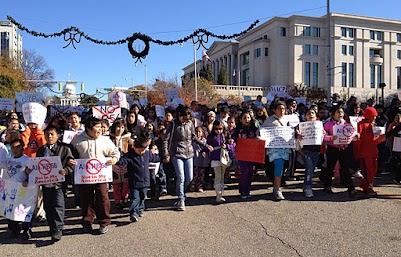
The movement in Alabama right now is probably one of the most inspiring examples of immigrant communities coming together with African Americans and building unity on a state wide level. Immigrants are getting organized and forming new organizations all over the state. In late December we held a rally in Montgomery. Community leaders mobilized over 26 buses from around the state and 3,000 people to march to the Governor’s mansion. Hundreds of children led the march bringing letters they had written to the Governor asking him to repeal HB 56.
That afternoon we held a strategy meeting with immigrant leaders. Community leaders representing all regions of the state shared the success from their efforts over the past 3 months and their strategies for building up power in the coming period to fight for repeal of HB 56. Just this week we held another strategy retreat with over 85 immigrant leaders representing cities from around the state, building up organizing skills and collectively setting the priorities for the legislative and organizing struggle ahead. Feb 7th, the first day of the legislature is the next big action in Montgomery.

We are also amidst a major education and organizing campaign happening among communities of faith. Immigration 101 workshops are being held in churches across the state and hundreds of faith leaders are speaking out against the law.

As the impacts become more widely felt and recognized unlikely allies, such as Republican farmers, local and international business owners, business associations, city chambers of commerce, mayors, county sheriffs and police chiefs are coming out against the law. The implementation of the law is having deep economic impacts, with a loss of skilled workers, businesses shutting down, loss of jobs and of state tax revenues.

International businesses are canceling projects in AL, because it is not safe for their workers. Farmers whose tomatoes rotted in the field because all their workers fled the state have confronted the Governor with buckets asking if he would help pick the crops. The Alabama Farmers Federation estimated the sector would suffer $63 million in losses as the result of the new law going into effect. The Sheriff of Jefferson County spoke at a congressional hearing stating that the police force absolutely does not have the resources or training to take on the role of immigration enforcement and admitted that the law requires his officers to racially profile. A survey done showed that the majority of Alabamians are now against the law.
It is becoming more and more clear that HB 56 a law driven by racism and scapegoating is a false solutions to economic problems and will not fix the economy but devastate the lives of thousands and hurt all Alabamians morally, spiritually and economically. Also ever-present is the potential national impact of the struggle and possible deep effects of a repeal of HB 56. This law is the most aggressive and extensive statewide anti-immigrant bill in the country with 30 different provisions.

Below are some of the harshest pieces of the law that are in effect and just some of the stories of the real human impacts:

1) Police are required to check the immigration status of people they stop and reasonably suspect to be in the country unlawfully.
Impacts:
Racial profiling of all people who are brown and or have accents. People are afraid to leave their homes, afraid to drive to work, to school, to the grocery store. People have feelings of being hunted and constantly surveilled. A 13-year-old told me she sends text messages to her parents all day while she is at school fearing everyday may be the day she loses her parents because they have been detained and deported during a traffic stop. A mother I met started having panic attacks from the stress of fearing she will be torn apart from her children and deported. A judge advised a lawyer that the lawyer had an obligation to report her own client to ICE as undocumented. The same judge stated that he might have to report to ICE any person who asked for an interpreter, as such a request would be a red flag.* Latino workers on a construction jobsite were threatened by a group of men with guns, who told them to go back to Mexico and threatened to kill them if they were there the following day. They declined to report the crime to law enforcement because of fears of what would happen to them if they did.* A victim of domestic violence went to court to obtain a protective order. The clerk told her that she’d be reported to ICE if she proceeded.* Much, much more…

2) All new contracts between an undocumented immigrant and another person are unenforceable in state court.
Impacts:
In Northport, the water authority provided notices to Latino customers that their services will be shut off if they didn’t provide proof of immigration status immediately.* In Madison County and in Decatur, the public utilities have announced that they will not provide water, gas, or sewage service to people who could not prove their status.* A women called and said the manager of her trailer parked asking residents to prove their status and then evicted everyone, claiming their leases where now null and void. A mother took her ill child to the hospital and was denied health care and thus service. A husband called us to report that his wife, nine months pregnant, was too afraid to go to a hospital in Alabama to give birth, and that he was trying to decide whether to have her give birth at home or somehow to try to get to Florida.* Clerks at Walmart have asked Latinos to show an Alabama drivers license in order to check out. A mother spoke to the local office of the Department of Human Resources about her US citizen children's eligibility for food stamps. The social worker told the mother that she would be turning the mother into the federal government for deportation. The family went into hiding.*

3) It is a felony for undocumented immigrants to enter into a “business transaction” with the state of Alabama.
Impacts:
People could not renew car tags, providing more excuses for the police to stop them. People could not renew their tags for their mobile homes; causing fear people may lose their homes. Immigrant owned businesses went under causing more unemployment and decrease in revenue for the state. A Latino man was arrested and detained. While in jail, he was told that he could not use the telephone to call his attorney because the use of the phone would be a “business transaction” prohibited by HB56* (the business transaction part of the law has recently been advised against enforcing by the AL attorney general and is changing in some parts of the state).

4) K-12 school officials are required to question students about their immigration status and that of their parents.
Impacts:
Parents were afraid to send their kids to school. 2500 children were taken out of school by their parents. Thousands more were absent in the first weeks. An ESL teacher told me the parents dropped their kids off at her house afraid the schools would report them to ICE if they took their children directly to school. Schools lost millions of dollars in federal funding, and thus jobs because of the un-enrollment of thousands. Racism and bullying has increased in the schools. Teachers jokingly made comments about ICE picking up absent Latino students. A group of immigrant children were denied the ability to participate on a sports team, with coaches stating they were not supposed to invest resources in immigrant children. (This part of the law went into effect and then was temporally enjoined two weeks later. However much damage was done.)

*Stories from the ACIJ hotline

Other provisions of the law have been temporarily blocked by the courts. These include provisions that:

● Prohibit residents from transporting or harboring undocumented immigrants

● Make it a traffic violation for motorists who stop in the roadway to hire a day laborer

● Prohibit universities from enrolling certain immigrants – including asylees, refugees or those granted temporary protected status

● Make it a misdemeanor for failing to complete or carry an alien registration card

● Prohibit employers from taking state tax deductions for wages paid to undocumented workers

● Allow employers to be sued for discrimination by people with U.S. citizen or legal immigration status when they are fired or not hired by an employer with undocumented employees

Because the law is so extensive AL citizens are taking on the role of interpreting the law on their own and enforcing it as they see fit. This is causing wide spread and deep human consequences.

The potential and impact of both our victories and losses in Alabama will be far reaching. Organizing resources in AL are very minimal and national solidarity and outcry against this law are imperative to whether AL sets the new standard for the level of racism, abuse and dehumanization that is acceptable and the new normal or whether this is the moment the tide really turns and laws like this become politically impossible.
What you can do:
Talk amongst your friends and organizations about how you can help build the movement nationally in support of the people of Alabama.
Learn from national solidarity organizing against Arizona’s SB 1070 (example: pass city council resolutions condemning HB 56 and committing your city to be a welcoming city to all. Organize artists to create visuals and cultures of resistance to HB 56). Also be creative and develop new ideas, then make a plan and make it happen.
Help organize an Occupy Day of Action in Solidarity with the people in AL and against racist false economic solutions such as scapegoating of immigrants.
The Alabama Coalition for Immigrant Justice needs resources to do the organizing on the ground. Organize a fundraiser to raise awareness and funds. Show your solidarity and make a meaningful personal donation at www.acij.net. Raise the national consciousness by getting and keeping what is happening in Alabama in the media, both mainstream and social media.
We need skilled organizers on the ground in Alabama (Spanish speaking a major plus). Fundraise in your community and come to AL for 2 weeks or longer and plug into a growing and imperative movement.

Thank you for reading this update and for your solidarity and support.

For more information and updates:

Alabama Coalition for Immigrant Justice (ACIJ)

100 Reasons Why Alabama’s Immigration Law is a Disaster

Ingrid Chapman is an anti-racist activist and until recently a member of the Catalyst Project. She spent many months in New Orleans post-Katrina volunteering with Peoples Hurricane Relief Fund, Common Ground, and other organizations.

Top image: Days after HB 56 went into effect, One Family One Alabama pray outside of church of HB 56 sponsor, Senator Scott Beason. 100 people came out with a day and half notice.
Other images: 3000 people rally in Montgomery against HB 56.

What Does Gender Have To Do With Housing? By Shana griffin

From the Bridge The Gulf website:
This article is adapted from my comments on the panel “Laying the Groundwork: Why do we need to understand gender to understand the major housing issues of our day?” with Gary Perry of Seattle University, and Charmel Gaulden with the Gulf Coast Fair Housing Center. The panel was part of the 2012 Fit for King summit on Women and Fair Housing, hosted by the Greater New Orleans Fair Housing Action Center with support from the Gulf Coast Fair Housing Center, Women’s Health & Justice Initiative, and the Anna Julia Cooper Project on Race, Gender and Politics in the South at Tulane University.

For the Women’s Health & Justice Initiative, our organizing acknowledges the intersections of gender and housing—as much of our advocacy challenges the use of social policies, and the ideologies embedded in them, that perpetuate violence in the lives of women of color. At WHJI, we organize from a framework that regards housing as a gendered phenomenon[1] – and as an important aspect of gender and racial inequalities.

By ‘gendered phenomenon’ I’m referring to the disproportionate utilization of public and subsidized housing programs among women of color and poor women; the gender disparities in high-cost subprime mortgage-lending, particularly among Black women; women and queer people’s elevated risk of vulnerability to poverty due to housing costs and discrimination; and the pervasive nature of gender-based violence in the context of accessing, securing, and maintaining one’s housing. Gender is an important dimension in understanding how access to housing is structured, how racial and economic disadvantage translates to housing disadvantage, and how housing disadvantages reinforce economic dependency and racial and gender segregation.

Access to housing is not only gendered, but varies amongst women according to structural forms of inequality and factors such as a women’s race, ethnicity, marital status, sexual orientation, income, ability, education, and whether or not her household includes children. We employ an ‘intersectional approach’ to examine and challenge these structural forms of inequality in shaping one’s access to housing.

Housing and housing policy are major areas of concern for us, as low-income women of color bear the brunt of housing related poverty, violence, discrimination, and displacement—much of which is the result of gender and racial inequality in society, gender blind housing policies, and myths and stereotypes of low-income communities and people of color.

Housing and reproductive violence

Our work examining the various ways reproductive violence[2] is embedded and manifested in housing policies show that women who are disproportionately impacted by housing discrimination are also disproportionately targeted by campaigns that seek to control their fertility and criminalize their reproductive capabilities.

As such, the utilization of government funded housing programs by poor women and women of color, particularly among black women, to secure housing for themselves and their families is often meet with racist and sexist stereotypes and stigmatizing labels associated with ‘welfare,’ ‘crime,’ ‘laziness,’ ‘uncontrolled-sexually,’ and ‘poverty’ in the housing market.

Stereotypes and stigmatizing labels such as these, implicitly and explicitly inform low-income women experiences and vulnerability to housing discrimination, ‘not-in-my-backyard’ attitudes, sexual harassment, residential segregation, and social isolation from needed resources.

The racial and gendered subtext of prevailing welfare and public housing assistance stereotypes are revealed in the attitudes and priorities of some policy makers.

Take for example comments made by Louisiana representative Richard Baker in response to public housing post-Hurricane Katrina: “We finally cleaned up public housing in New Orleans. We couldn‘t do it but God did.”

Or the racist and eugenic 2008 legislative plans of Representative John LaBruzzo to pay poor women $1,000 to get sterilized under the cloak of reducing the number of people on welfare and those utilizing public housing subsidies in Louisiana. He said, “I wonder if it might be a good idea to pay some of these people to get sterilized. My solution: pay impoverished women $1,000 to have their tubes tied so they will stop having babies they can’t afford.”

In September of 2008, when Mr. LaBruzzo’s infamous statements were made, the number of people receiving public cash assistance in Louisiana had dropped by 74% since Hurricane Katrina, and had be declining since the mid 1990s. Currently, less than 1% of Louisiana’s population receives ‘welfare’ or Temporary Assistance to Needy Families (TANF) – a number representing approximately 13,000 out of a population of 4.5 million people, with the vast majority of recipients being children and the average public assistance grant being $189 a month for a family of three.

The divestment and attacks on housing programs intended to assist low-income women violates the reproductive rights and autonomy of marginalized women, particularly the rights of women with children. Three core aspects of reproductive justice is the right to have children, the right not to have children, and the right to parent the children we have in safe and healthy environments with access to resources and enabling social conditions. Without access to safe, stable, and sanitary housing, the reproductive rights of women with children are constantly violated.

In an effort to address the multiple ways reproductive violence policies interact to regulate and police the lives of those existing and operating through identities and locations of subjugation, it is very important for us to have an intersectional understanding of gender and housing, and how housing policies shape and influence one’s health and well-being.

Housing is not simply about the dwelling in which one lives, but about how one is situated in a school district, a public transportation system, a job market, a social network, and a community of opportunity. Access to housing is not simply an exercise of finding somewhere to live, but is a continuous process of sustaining access and avoiding losing a home. Many of the challenges women face in securing and maintaining access to housing reflect and reinforce wider gender inequality in society.

The value of taking an intersectional approach

Organizing from an intersectional approach allows us to understand and respond to the ways gender and other identities intersect with housing policies and practices of discrimination – to work in coalition with not in isolation from other social justice, human rights, and service-based organizations without segmenting, isolating, or pitting one priority of our work against another.

For example:


Many black women who are Section 8 vouchers holders in the city often report discrimination in the private housing market at the hands of landlords who refuse to participate in the subsidized voucher program.

It is the intersection of the Section 8 voucher holder’s identities as

  • a woman,
  • a black person, and
  • a poor person

that puts her in the position of vulnerability. It is the intersection of policies, programs, and practices such as

  • fair housing laws,
  • subsidized housing programs, and
  • income discrimination

that support and maintain that vulnerability.

Instead of relying solely on fair housing enforcement organizations to remedy the discrimination experience by black women Section 8 voucher holders, engaging in an intersectional approach of housing justice would create opportunities for various organizations and advocacy approaches to be utilized.


Footnotes

[1] In talking about housing as a ‘gender’ phenomenon, it’s important to understand that the terms and identities "woman" and “women”, do not signal particular types of bodies or fixed gender identities. Women differ by age, race, ethnicity, gender expression and identity, sexuality, education, ability, relationship status, work sector, and citizenship status.

[2] For WHJI, reproductive violence refers to the methods used to sustain reproductive oppression. These methods include policies, laws, initiatives, behaviors, practices, and procedures designed to reduce, control, and/or eliminate the reproduction of marginalized communities, as well as regulate and repress one’s sexuality.

Shana griffin (37) is a life-long resident of New Orleans, mother of two, black feminist, researcher, and social justice activist, who has over 16 years experience organizing nationally and locally with low-income communities of color on critical issues pertaining to racial and gender justice; sexual health and reproductive justice; housing affordability; ending gender-based violence; prison abolition; gender and disaster vulnerability; just sustainabilities; education equity; and climate justice. Shana is co-founder of the Women’s Health & Justice Initiative, where she currently serves as Research & Advocacy Director (volunteer), and is the former Interim Director of the New Orleans Women’s Health Clinic she co-founded in 2007. Shana is a member of INCITE! and currently serves on the Board of Directors of Women With A Vision, Inc. and Jane Place Neighborhood Sustainability Initiative, a local neighborhood-based housing and community development non-profit.

The Women’s Health & Justice Initiative is a radical feminist of color organization based in New Orleans, dedicated to improving the social and economic health of women of color and our communities. For more info please visit: www.whji.org.

Photo: Shana griffin and Gary Perry discuss gender and housing at the Fit for King summit on Women and Fair Housing.

Monday, February 13, 2012

For Volunteers in New Orleans: Principles of Partnership, Collaboration, and the Struggle for Justice

More than six years after Hurricane Katrina, volunteers are still coming to New Orleans from across the US. We appreciate the solidarity, but we also think it is important to be conscious of the limits of volunteerism. In that spirit, we believe it is useful to republish this 2007 letter, originally written by Bill Quigley.

We hope volunteers coming to New Orleans to support rebuilding justice for our city will read this letter, and think about it as they approach their volunteer efforts. The letter is reprinted in full below:

Letter to Katrina Volunteers and Partners 2007 Principles of Partnership, Collaboration, and the Struggle for Justice

An aboriginal activist said it best: "If you have come to help me, you are wasting your time. If you have come because your liberation is bound up with mine, then let us struggle together."

Our community needs the solidarity, action and support of people and institutions from local, regional, national and international areas and all walks of life in our struggle for justice. New people and organizations can bring our community much needed new ideas, new resources, and new ways of looking at issues. Our justice struggles bind us together and we must proceed in ways that respect all of the participants.

Solidarity, action and support must be based on respect of the dignity and ongoing history of the people and work that has already occurred in our community. It is an unfortunate fact that there are numerous examples of people and organizations from outside the community who come to local justice efforts and, despite their very best intentions, make mistakes that actually harm the ongoing local justice work. Those who made the mistakes then leave the community and return to their own communities. The difficult work left behind, the work of reconstruction and reconciliation and dealing with unmet promises or unachievable expectations, adds to the ongoing work which must be done by local justice workers.

In order to minimize mistakes and missteps by volunteers, short-term workers, or newly arrived or newly engaged people and organizations, we ask each partner to respect the work that has already gone on and the history that has occurred. In order to respect this work and history, people must first learn it.

Practically, this respect means that for newcomers to the community, listening is more important than speaking, learning must be prized over teaching, and reflection with the community must precede action. Most importantly, people should not take actions or make verbal commitments or raise expectations in the community that are not achievable. Unmet promises and unfilled expectations seriously undermine and discourage local organizing and justice work.

We ask our partners to agree to struggle with us in a principled way. The principles that should guide our partnership include that every person and organization starts out with a presumption of respect. New people or organizations joining this work agree to learn the local people, the local history of our justice struggles, and the local community justice situation before taking independent action. People or organizations who join this work agree to engage in real dialogue on all issues before taking independent action.

Once new people and organizations have spent the time and energy to begin to learn about local issues and our community, real partnership then means mutual accountability with the other partners and mutual supervision and mutual discussion about plans, resources, people, and work before, during and after steps are taken.

We expect to learn from our new volunteers and partners. We expect our partners will learn from us. We hope these principles will guide us in creating mutual and meaningful partnerships which can help all of us join in advancing the struggles for justice in our community.

Photo above from blackboard in St Mary's School, Upper Ninth Ward.

How Much is a Black Vote Worth? Who Wants to Buy it? And Who is Willing to Sell? By Parnell Herbert

On May 10, 1994 former political prisoner Nelson Rolihlahla Mandela was elected the first Black President of South Africa.

I remember seeing a newspaper photograph of three elderly South African women. Two of them struggled as they carried the third woman between them by her arm pits, for the third woman had no legs. The caption below the photo spoke of the many miles these women had trekked tired and worn but determined. Nothing would stop them from the privilege of exercising their newly earned right to vote.

When there are local elections (nothing really important on the ballot), I hesitate to get out of my recliner, turn off the TV, walk out the door, get into my car and drive a few blocks to vote. I think back to that photo and I think back to the people in the US who suffered and died to earn the right for me to vote.

The memory of those elders and the vision of that photograph inspire me to get out and vote. I think of the selfish and complacent society we have become. I think of how we disregard and disrespect the memories of the people on whose shoulders we stand.

Even more distasteful to me are the people who are willing to sell their votes, sell their souls and sellout their people. Reportedly white City Councilwoman Stacey Head attempted to buy votes in a large Black church with a $1,500 check and a kiss on the cheek from a Black City Councilman.

A few days later, Head spoke on a local Black radio show. Several regular callers say they were blocked from calling in to confront and/or to challenge some of Head’s statements and her record during her eight years in office. Today we can hear the lovely voice of actress Vanessa Williams as she provides us with a Black history moment followed by an anonymous voice; “This Black history moment was paid for by Stacy Head.”

While some bloggers and newsletters will report news stories open and honestly there are others who seem to depend on Mayor Mitch Landrieu to feed their families. These writers will send out news reports but will not report negative news about their mayor. They may sometimes even promote their mayor.

We have all heard stories of political organizations with names like BOLD, SOUL, COUP as well as other like organizations. Now we have Democratic politicians being financed by Republican dollars.

In order to complete a sale there must be an agreement between both the buyer and the seller. There must also be a reason and even a desire to buy and to sell. There is no problem understanding the purpose of the buyer. In this case they want to buy themselves a job.

The seller on the other hand is not as easy to understand. Why does a man sell his vote, sell his soul and sellout his people?

I really wish I had saved that photograph of those three women in South Africa eighteen years ago. I wish others could see it now and know the story behind it. Maybe then there would be some degree of conscious thought and foresight before we set a price on our vote and on our people.

Parnell Herbert is a recently returned New Orleanian who was previously displaced to Houston by Hurricane Katrina. He is active on many social justice causes, including the right of return for New Orleanians, and freedom for the Angola Three. His new play, Angola Three, has been performed in New Orleans and other cities.

Tuesday, February 7, 2012

Sentencing in Noose Incident at Louisiana Middle School

Three men, aged 21 - 25, were sentenced today in an incident in which they sought to intimidate African American children away from attending a school in Morehouse Parish, LA. The school had recently seen increased enrollment by Black students because of a new busing policy.

In other news, the FBI has reportedly also joined in an investigation of a potential hate crime in Washington Parish.

More info on the sentencing in Morehouse is in the Justice Department press release, reprinted here:
The Department of Justice announced today that three men were sentenced for a federal hate crime stemming from an incident that took place at Beekman Junior High School in Beekman, Morehouse Parish, La. U.S. Magistrate Judge Karen Hayes sentenced James Lee Wallis Jr. to eight months in prison, Tony L. Johnson to six months in prison and Brian Wallis to five months in prison. All three defendants will also receive one year of supervised release and must attend a cultural diversity and sensitivity program.

On Aug. 12, 2011, defendant Johnson pleaded guilty to intentionally attempting to intimidate and interfere with African-American students who were attending Beekman Junior High School. Brothers Brian Wallis, 21, and James Lee Wallis Jr., 25, pleaded guilty to the same offense on Sept. 2, 2011. During their respective plea hearings, all three defendants admitted that they hung a dead raccoon in a noose from a flagpole located in front of Beekman Junior High School. They each further admitted that they were angered by the school’s new busing policy, which had increased the number of African-American children attending the school, and that they wanted to scare the African-American children into leaving the school.

“Every child, regardless of race, is entitled to an education free from intimidation or discrimination,” said Thomas E. Perez, Assistant Attorney General for the Civil Rights Division. “Unfortunately, acts of hate such as this one are all too common in this country in 2012. The Justice Department will continue to enforce our nation’s civil rights laws in order to protect the most vulnerable in our society.”

“There is no place in our schools for this kind of intimidation,” said Stephanie A. Finley, U.S. Attorney for the Western District of Louisiana. “Every child has the right to an education and to feel safe in school. I hope this case sends a message that this type of activity will not be taken lightly.”

This case was investigated by the FBI and prosecuted by Senior Litigation Counsel Mark Blumberg and Trial Attorney Christine M. Siscaretti of the Justice Department’s Civil Rights Division and Assistant U.S. Attorney Mary J. Mudrick for the Western District of Louisiana.